Burgers Viscous 1D
This example solves the viscous Burgers equation with a manufactured exact solution and demonstrates RAD adaptive resampling — a technique that concentrates collocation points in high-residual regions to accelerate convergence.
Problem Setup
The PDE has the form u_t + u u_x = ν u_xx + f, with manufactured solution u_exact = e^{-t} sin(πx) and the corresponding forcing term f.
The domain [0,1] × [0,1] is discretised as a 2D rectangle with x (space) and t (time) treated as two spatial coordinates — the standard PINN formulation that makes full adaptive resampling available.
Step 1: Define the Resampling Strategy
RAD fires every 200 epochs (starting at epoch 500 once the network has formed a rough solution), replacing 20 % of working-set points with draws from the full 513-node mesh pool, biased toward regions of high PDE residual.
from jno import sampler

strategy = sampler.rad(
    resample_every=200,    # check for updates every 200 epochs
    resample_fraction=0.2, # replace 20 % of working-set points
    start_epoch=500,       # wait for a rough solution before resampling
    k=5,                   # cluster around the top-5 high-residual anchors
)
Step 2: Build the Space-Time Domain
mesh_size=0.05 on [0,1]² gives 513 interior nodes in the candidate pool. With sample=(60, None), the network trains on a 60-point working set — an 8× pool-to-sample ratio that gives RAD substantial room to move points into high-residual regions.
domain = 1 * jno.shape.rect(0.0, 0.0, 1.0, 1.0, size=0.05).domain()
vars_int = domain.variable("interior", sample=(60, None), resampling_strategy=strategy)
x, t = vars_int[0], vars_int[1]

# IC boundary: t = 0 (bottom face of the rectangle)
vars_bot = domain.variable("bottom", sample=(20, None))
x0, t0 = vars_bot[0], vars_bot[1]
Step 3: Define the Network and PDE
An MLP with 2 inputs (x, t) takes both coordinates directly. The x*(1-x) factor hard-encodes the Dirichlet BCs u(0,t) = u(1,t) = 0.
net = jno.nn(foundax.mlp(2, hidden_dims=64, num_layers=4, key=jax.random.PRNGKey(3)))
net.optimizer(optax.adam(optax.warmup_cosine_decay_schedule(init_value=0.0, peak_value=1e-3, warmup_steps=1, decay_steps=10, end_value=1e-5)))

u = net(x, t) * x * (1 - x)

u_t  = u.d(t)
u_x  = u.d(x)
u_xx = u_x.d(x)
pde  = u_t + u * u_x - ν * u_xx - source
Step 4: Train and Evaluate
u_0 = net(x0, t0) * x0 * (1 - x0)
ini = u_0 - jno.np.sin(π * x0)

crux    = jno.core([pde.mse, ini.mse])
history = crux.solve(5000)

_u, _u_exact = crux.eval([u, u_exact])
rel_l2 = float(jax.numpy.linalg.norm(_u - _u_exact) / (jax.numpy.linalg.norm(_u_exact) + 1e-8))
Result
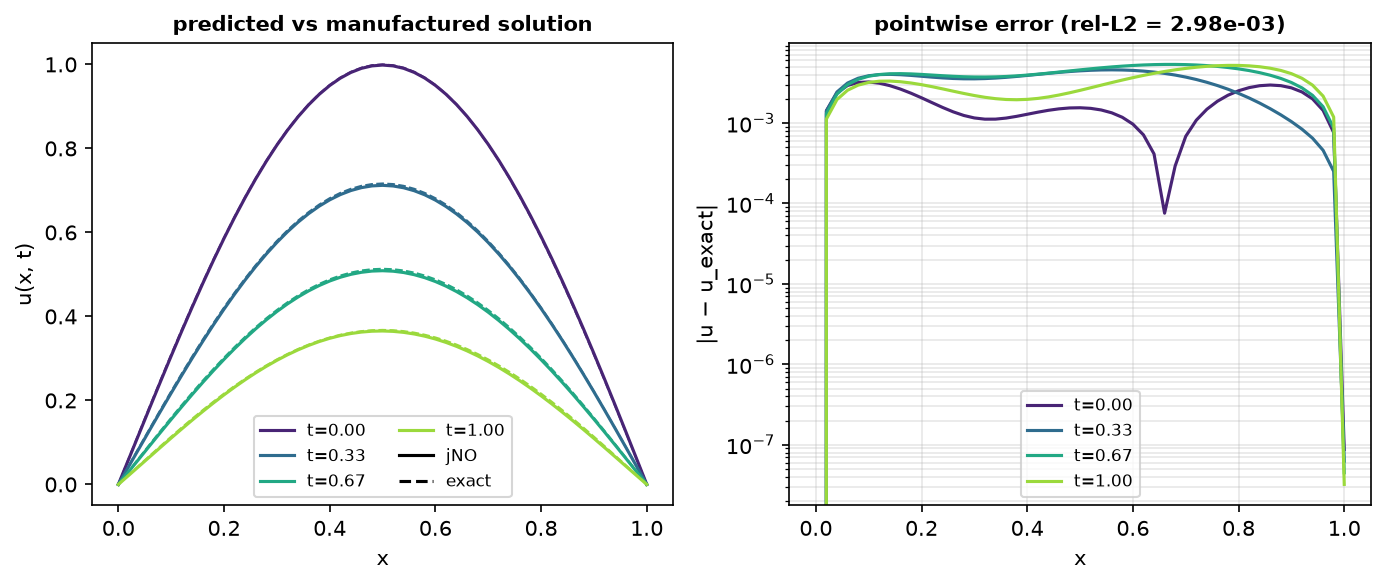
The trained network reproduces the manufactured travelling profile at every time level, matching the exact solution \(u^*=e^{-t}\sin(\pi x)\) to rel-\(L^2\approx9.5\times10^{-4}\). The pointwise error (right) stays around \(10^{-3}\) across the domain, with RAD keeping the residual balanced near the moving front.
What To Notice
- Adaptive resampling: the
interiorvariable is sampled withjno.sampler.rad(...), so after the warm-up phase RAD progressively relocates interior collocation points toward the steep, high-residual moving front. - The nonlinear term
u u_xcreates residuals that are largest nearx = 0.5(the maximum ofsin(πx)). After the warm-up phase, RAD progressively moves interior points toward that region. - The pool-to-sample ratio (8×) is what gives RAD room to relocate points. A ratio below 2× leaves too few candidates to draw from.
- The initial-condition boundary (
t = 0, sampled via"bottom") is kept fixed — only interior points are resampled. - For the classic inviscid-limit Burgers benchmark (
ν = 0.01/π, no forcing, ICu(x,0) = -sin(πx)), the steep gradient forms nearx = 0at late times and RAD provides the largest gains. Seeadaptive/resampling.mdfor that setup.
Script Snippet
"""04 — 1-D viscous Burgers equation  (manufactured solution)"""

import foundax
import jax
import optax

import jno

π = jno.np.pi
ν = 0.05
T_end = 1.0

# ── Domain (1-D space × time) ─────────────────────────────────────────────────
domain = jno.Path(0.0, 0.0).line_to(1.0, 0.0).curve(size=0.1).domain(time=(0, T_end, 4))
# RAD adaptive resampling concentrates collocation points at the steep moving front.
x, t = domain.variable(
    "interior",
    resampling_strategy=jno.sampler.rad(resample_every=200, resample_fraction=0.2, start_epoch=500, k=10),
)
x0, t0 = domain.variable("initial")

# ── Manufactured solution + source term ──────────────────────────────────────
u_exact = jno.np.exp(-t) * jno.np.sin(π * x)
source = jno.np.exp(-t) * (ν * π**2 - 1) * jno.np.sin(π * x) + (π / 2) * jno.np.exp(-2 * t) * jno.np.sin(2 * π * x)

# ── Network  (hard Dirichlet BCs via the x(1-x) factor) ──────────────────────
net = jno.nn(
    foundax.deeponet(
        n_sensors=1,
        coord_dim=1,
        n_outputs=1,
        n_layers=4,
        basis_functions=64,
        hidden_dim=48,
        key=jax.random.PRNGKey(3),
    )
)
net.optimizer(
    optax.adam(
        optax.warmup_cosine_decay_schedule(
            init_value=0.0, peak_value=1e-3, warmup_steps=10, decay_steps=5000, end_value=1e-5
        )
    )
)

u = net(t, x) * x * (1 - x)

# ── PDE residual:  u_t + u u_x − ν u_xx − f = 0 ──────────────────────────────
u_x = u.d(x)
pde = u.d(t) + u * u_x - ν * u_x.d(x) - source

# ── Initial condition ────────────────────────────────────────────────────────
u_0 = net(t0, x0) * x0 * (1 - x0)
ini = u_0 - jno.np.sin(π * x0)

# ── Solve ────────────────────────────────────────────────────────────────────
crux = jno.core([pde.mse, ini.mse])
crux.solve(5000)

_u, _u_exact = crux.eval([u, u_exact])
rel_l2 = float(jax.numpy.linalg.norm(_u - _u_exact) / (jax.numpy.linalg.norm(_u_exact) + 1e-8))
assert rel_l2 < 1e-1, f"relative L2 error too large: {rel_l2:.3e}"