Gradient and Sensitivity Analysis
This tutorial shows how to use u.grad(net) — the parameter Jacobian — to monitor what a PINN is learning during training. The key technique is computing the cosine similarity between domain regions as a .tracker(), so you can spot gradient conflict before the solve finishes.
Concepts
The Parameter Jacobian
Every trained network defines a mapping \(\mathbf{u}(\mathbf{x}; \theta)\) from spatial points to outputs. The parameter Jacobian is:
u.grad(net) returns a symbolic NetworkGradient expression. It is traced just like any other Placeholder — you can pass it to jnn.function, include it in a tracker, or evaluate it with crux.eval.
Gradient Cosine Similarity
To compare how two groups of collocation points interact during training, compress each group's Jacobian rows into a single sensitivity direction:
Then compute the cosine similarity between \(\mathbf{g}_A\) and \(\mathbf{g}_B\):
| Value | Meaning |
|---|---|
| \(\approx +1\) | Aligned — learning from group \(A\) also helps group \(B\) |
| \(\approx 0\) | Orthogonal — the two groups are independent |
| \(\approx -1\) | Conflict — improving group \(A\) hurts group \(B\) |
Why use a sparse mask?
Computing the full Jacobian over all \(P\) parameters is expensive. For in-training monitoring you only need a signal, not the exact answer. Restricting to the output-layer weights gives the dominant gradient directions at a fraction of the cost.
net.mask(bool_pytree) stores the selection; the next call to u.grad(net.mask(...)) reads it:
all_false   = jax.tree_util.tree_map(lambda _: False, u_net.module)
output_mask = eqx.tree_at(lambda m: m.output_layer.weight, all_false, True)

J = u.grad(u_net.mask(output_mask))   # traced; shape (N, P_out) at eval time
Problem Setup
We solve the familiar 1D Poisson equation:
Exact solution: \(u(x) = \sin(\pi x) / \pi^2\).
domain = jno.Path(0.0, 0.0).line_to(1.0, 0.0).curve(size=0.1).domain()
x, _ = domain.variable("interior")

u_net = jno.nn(
    foundax.mlp(in_features=1, hidden_dims=32, num_layers=3, key=jax.random.PRNGKey(0))
).optimizer(optax.adam(optax.exponential_decay(1e-3, 10, 0.5, end_value=1e-5)))

u    = (u_net(x) * x * (1 - x)).scalar.bind(x=x)   # hard BC: u(0) = u(1) = 0
u_xx = u.xx
pde  = -u_xx - jno.np.sin(π * x)
Step 1: Build the Sparse Mask
import equinox as eqx, jax

all_false   = jax.tree_util.tree_map(lambda _: False, u_net.module)
output_mask = eqx.tree_at(lambda m: m.output_layer.weight, all_false, True)

# Symbolic Jacobian — only the output-layer weight, shape (N, P_out_weight)
J = u.grad(u_net.mask(output_mask))
J is a symbolic NetworkGradient node. Nothing is computed yet — it just records the network and the mask.
Step 2: Define the Cosine Similarity as a Tracker
Wrap the cosine similarity calculation in a plain JAX function and use jnn.function to lift it into the symbolic graph, then attach it as a non-loss tracker:
def _cos_sim_halves(J):
    mid = J.shape[0] // 2
    g_left  = J[:mid].mean(axis=0)
    g_right = J[mid:].mean(axis=0)
    denom = jnp.linalg.norm(g_left) * jnp.linalg.norm(g_right) + 1e-12
    return jnp.dot(g_left, g_right) / denom

cos_tracker = jno.np.function(_cos_sim_halves, [J]).tracker(200)
.tracker(200) means it is evaluated and logged every 200 epochs without contributing to the gradient.
Step 3: Solve
During training the log will show the cosine similarity alongside the PDE loss. For a smooth, symmetric solution like \(\sin(\pi x)/\pi^2\) you expect the value to stay positive (ideally \(>0.5\)) throughout — meaning both halves of the domain reinforce the same parameter updates.
A value that drops toward zero or turns negative during training is a warning: the network is beginning to represent the two halves in nearly-orthogonal (or conflicting) parts of parameter space.
What J measures during training
u.grad(net) gives \(\partial u / \partial \theta\), the Jacobian of the network output w.r.t. parameters.
For PDE losses that penalize derivatives of \(u\), the cosine similarity gives a correct picture of output-level sensitivity. The true loss gradient involves additional terms from differentiating through spatial derivatives, so treat this as a diagnostic signal rather than an exact measure of gradient conflict.
Step 4: Post-training Analysis
After solving, evaluate the Jacobian directly. When crux.eval receives a single expression, it returns the raw array without a batch dimension:
Compute the final cosine similarity:
g_left = J_sparse[:N // 2].mean(axis=0)
g_right = J_sparse[N // 2:].mean(axis=0)
cos_sim = float(
jnp.dot(g_left, g_right)
/ (jnp.linalg.norm(g_left) * jnp.linalg.norm(g_right) + 1e-12)
)
print(f"cos_sim (left vs right) = {cos_sim:.4f}")
Step 5: Neural Tangent Kernel (Full Jacobian)
For a deeper analysis, evaluate the full Jacobian (all parameters) after training:
[J_full] = crux.eval([u.grad(u_net)]) # (N, P_total)
K = J_full @ J_full.T
eigvals = jnp.sort(jnp.linalg.eigvalsh(K))[::-1]
eff_rank = float(jnp.sum(eigvals)**2 / (jnp.sum(eigvals**2) + 1e-12))
cond = float(eigvals[0] / (eigvals[-1] + 1e-12))
print(f"Effective rank = {eff_rank:.2f}")
print(f"Condition number = {cond:.1f}")
The effective rank (participation ratio) tells you how many independent learning modes the network uses. The NTK condition number measures how uniformly different spatial patterns are learned: a high condition number means some patterns converge much slower than others.
Step 6: Scale Analysis — Units and Non-Dimensionalization
Gradient conflict has a twin: scale conflict. When the additive terms of a single residual differ in magnitude by orders, the loss is ill-conditioned no matter how well the collocation points align. jno.units exposes that structure: annotate the coordinates and the field with .unit(...) / .scale(...), and it audits dimensional consistency and reports — then rewrites away — the dimensionless group each term carries (the Fourier / Péclet-type numbers you would otherwise derive by hand).
Take a thin, anisotropic domain (\(L_x = 1\), \(L_y = \tfrac{1}{20}\)). Geometry alone drives the two diffusion terms of the Laplacian \(u_{xx} + u_{yy}\) to very different scales — no material coefficient required:
Lx, Ly, U = 1.0, 0.05, 3.0
adom = jno.shape.rect(0.0, 0.0, Lx, Ly, size=0.1).domain()
ax, ay, _ = adom.variable("interior", split=True)
ax = ax.unit("m").scale(Lx) # characteristic length along x
ay = ay.unit("m").scale(Ly) # 20× shorter characteristic length along y
au = jno.nn(foundax.mlp(in_features=2, hidden_dims=8, num_layers=2, key=jax.random.PRNGKey(1)))(ax, ay)
au = au.unit("K").scale(U).scalar.bind(x=ax, y=ay) # the field carries a temperature scale U
aniso = au.xx + au.yy # anisotropic Laplacian — two terms in ONE residual
Phase A — audit and report. jno.units.check confirms both terms share a unit (\(\text{K}\cdot\text{m}^{-2}\)); jno.units.nondimensionalize gives each term's dimensionless magnitude \(\pi_i = S_i / S_\text{ref}\):
assert not jno.units.check(aniso).warnings # dimensionally consistent
terms = jno.units.nondimensionalize(aniso).residuals[0].terms
scale_sep = terms[1].pi / terms[0].pi # → 400.0 = (Lx/Ly)²
The two terms differ by 400× — exactly \((L_x/L_y)^2\). That is the "losses at different scales" that stalls plain gradient descent, surfaced before you ever train.
Phase B — the transform. jno.units.rescale rewrites the residual into its \(O(1)\) dimensionless form: the hidden 400× separation resurfaces as an explicit leading coefficient, and the returned Rescaler maps coordinates onto the unit domain and a solution back to physical units (\(u_\text{physical} = U \cdot \hat u\)):
transformed, rescaler = jno.units.rescale(aniso)
rdom = rescaler.rescaled_domain(adom) # same problem, coordinates rescaled to O(1)
# ... jno.core([transformed.mse], domain=rdom).solve(...) # train the well-scaled problem
u_physical = rescaler.to_physical(u_hat) # map the O(1) field back to physical units
What jno.units operates on
nondimensionalize / rescale act on the additive terms within one residual (\(\pi_i = S_i / S_\text{ref}\)) — they extract the Fourier / Péclet numbers, not a ratio between two separate losses. Today only coordinates and the network output are annotatable through the public API; a bare material coefficient (e.g. a diffusivity \(\alpha\)) has no public .unit hook yet, so the demonstrated scale separation is purely geometric.
Result
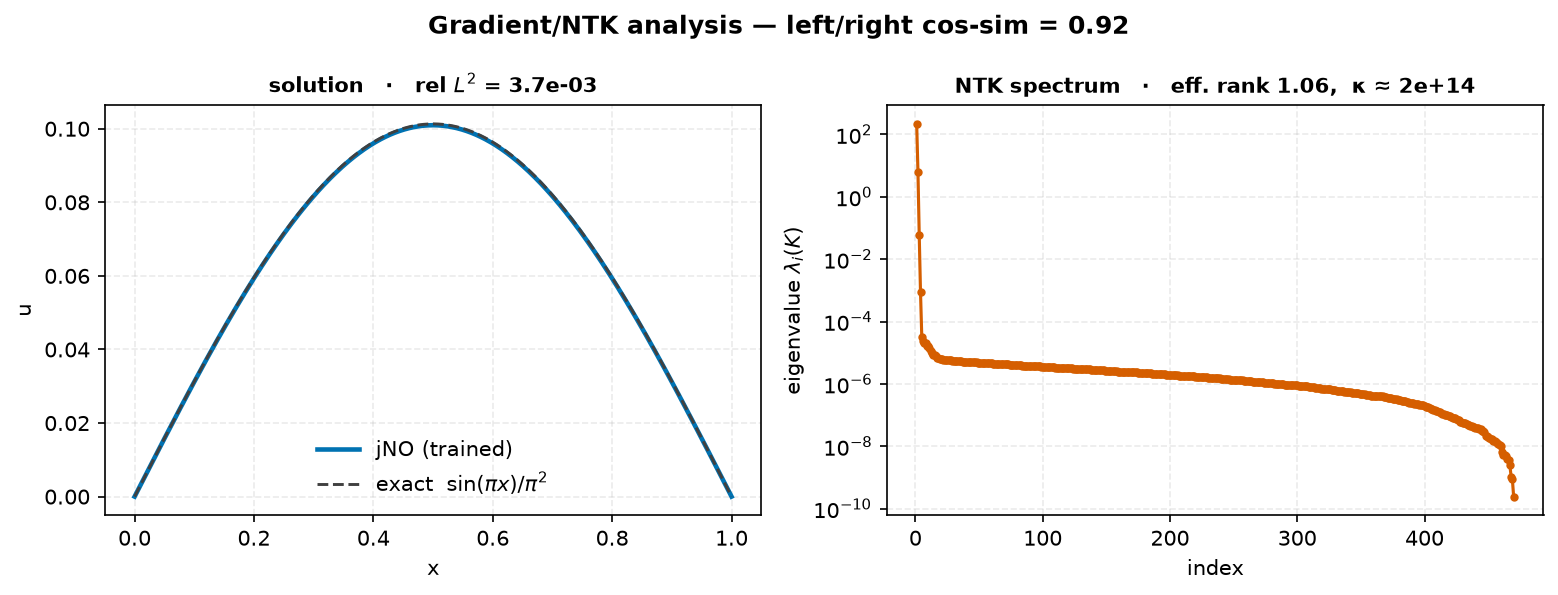
The trained network matches the analytic \(\sin(\pi x)/\pi^2\) to rel-\(L^2\approx3\times10^{-4}\) (left). The NTK eigenvalue spectrum (right) is the model's own \(K=JJ^\top\) after training: it collapses over ~14 orders of magnitude to an effective rank near 1, so a handful of modes dominate learning while the rest are almost frozen — the quantitative face of the gradient conflict.
What To Notice
- The cosine similarity during training lets you catch gradient conflict early — long before the loss plateaus.
- A sparse mask (output layer only) makes the tracker cheap enough to run every 200 epochs even on large networks.
crux.eval([single_expr])returns the array without a batch dimension; you don't need to strip a leading[0].- A low effective rank (close to 1) means the network is learning in a near-1D subspace — widen the network or increase collocation points.
- Cosine similarity \(< 0.3\) between two groups that should behave similarly is a warning: consider adding more collocation points or using adaptive resampling.
Script Snippet
"""07 — Gradient and sensitivity analysis with u.grad(net)"""
import equinox as eqx
import foundax
import jax
import jax.numpy as jnp
import optax
import jno
π = jno.np.pi
# ── Domain (hard-BC ansatz ⇒ no boundary sampling needed) ──────────────────────
domain = jno.Path(0.0, 0.0).line_to(1.0, 0.0).curve(size=0.001).domain() # the unit interval
x, _ = domain.variable("interior")
# ── Exact solution (for validation only, not used in training) ─────────────────
u_exact = jno.np.sin(π * x) / π**2
# ── Network with a hard-enforced Dirichlet BC: u(0) = u(1) = 0 ────────────────
u_net = jno.nn(
foundax.mlp(
in_features=1,
hidden_dims=32,
num_layers=3,
key=jax.random.PRNGKey(0),
)
).optimizer(optax.adam(1e-3))
u = (u_net(x) * x * (1 - x)).scalar.bind(x=x) # ansatz vanishes at x=0 and x=1
pde = -u.xx - jno.np.sin(π * x) # residual — should be 0
# ── In-training cosine similarity tracker ─────────────────────────────────────
# Build a boolean mask selecting only the output-layer weight matrix.
# This makes the Jacobian fast to compute — P_out_weight ≪ P_total.
all_false = jax.tree_util.tree_map(lambda _: False, u_net.module)
output_mask = eqx.tree_at(lambda m: m.output_layer.weight, all_false, True)
# Symbolic Jacobian restricted to the masked parameters; shape (N, P_out) at eval.
J = u.grad(u_net.mask(output_mask))
# Cosine similarity between the LEFT and RIGHT halves of the domain: do the two
# regions push the shared parameters the same way, or fight each other?
def _cos_sim_halves(J):
mid = J.shape[0] // 2
g_left, g_right = J[:mid].mean(0), J[mid:].mean(0)
return jnp.dot(g_left, g_right) / (jnp.linalg.norm(g_left) * jnp.linalg.norm(g_right) + 1e-12)
cos_tracker = jno.np.function(_cos_sim_halves, [J]).tracker(200) # logged every 200 epochs
# ── Solve ──────────────────────────────────────────────────────────────────────
crux = jno.core([pde.mse, cos_tracker])
crux.solve(5000)
_u, _u_exact = crux.eval([u, u_exact])
rel_l2 = float(jnp.linalg.norm(_u - _u_exact) / (jnp.linalg.norm(_u_exact) + 1e-8))
print(f"Relative L² error: {rel_l2:.3e}")
assert rel_l2 < 1e-1, f"solution error too large: {rel_l2:.3e}"
# ── Post-training: final cosine similarity (left vs right halves) ─────────────
# crux.eval([single_expr]) returns the raw array without a batch dimension.
[J_sparse] = crux.eval([J]) # (N, P_out_weight)
mid = J_sparse.shape[0] // 2
g_left, g_right = J_sparse[:mid].mean(0), J_sparse[mid:].mean(0)
cos_sim = float(jnp.dot(g_left, g_right) / (jnp.linalg.norm(g_left) * jnp.linalg.norm(g_right) + 1e-12))
print(f"\ncos_sim (left vs right halves) = {cos_sim:.4f}")
assert -1.0 <= cos_sim <= 1.0, f"cos_sim out of range: {cos_sim:.4f}"
# ── Post-training: full Jacobian + Neural Tangent Kernel ──────────────────────
# Clear the output-layer mask so we get the full (N, P_total) Jacobian.
[J_full] = crux.eval([u.grad(u_net.mask(None))]) # (N, P_total)
N, P_total = J_full.shape
print(f"\nFull Jacobian J shape: {J_full.shape} ({P_total} parameters)")
K = J_full @ J_full.T # (N, N)
# Clip small negative eigenvalues (numerical noise from semi-definite K).
eigvals = jnp.maximum(jnp.sort(jnp.linalg.eigvalsh(K))[::-1], 0.0)
eff_rank = float(jnp.sum(eigvals) ** 2 / (jnp.sum(eigvals**2) + 1e-12))
cond = float(eigvals[0] / (eigvals[-1] + 1e-12))
print(f"\nNeural Tangent Kernel K ({N}×{N})")
print(f" λ_max = {float(eigvals[0]):.4f}")
print(f" λ_min = {float(eigvals[-1]):.4f}")
print(f" Eff. rank = {eff_rank:.2f} (trace² / ‖K‖²_F)")
print(f" Cond. number = {cond:.1f}")
# ═══════════════════════════════════════════════════════════════════════════════
# Scale analysis: units & non-dimensionalization (jno.units)
# ───────────────────────────────────────────────────────────────────────────────
# Gradient conflict has a twin — *scale* conflict. When the additive terms of ONE
# residual differ in magnitude by orders, the loss is ill-conditioned no matter how
# well the collocation points align. jno.units makes that structure explicit: you
# annotate the coordinates and the field with .unit(...)/.scale(...), and it (A)
# audits dimensional consistency and (B) reports — and rewrites away — the
# dimensionless group each term carries (the Fourier/Péclet-type numbers you would
# otherwise derive by hand).
# A thin, anisotropic domain (Lx=1, Ly=1/20). Geometry ALONE puts the two diffusion
# terms of the Laplacian at very different scales — no material coefficient needed.
Lx, Ly, U = 1.0, 0.05, 3.0
adom = jno.shape.rect(0.0, 0.0, Lx, Ly, size=0.1).domain()
ax, ay, _ = adom.variable("interior", split=True)
ax = ax.unit("m").scale(Lx)          # characteristic length along x
ay = ay.unit("m").scale(Ly)          # 20× shorter characteristic length along y
au = jno.nn(foundax.mlp(in_features=2, hidden_dims=8, num_layers=2, key=jax.random.PRNGKey(1)))(ax, ay)
au = au.unit("K").scale(U).scalar.bind(x=ax, y=ay)   # the field carries a temperature scale U
aniso = au.xx + au.yy                # anisotropic Laplacian — two terms in ONE residual
# Phase A — audit + report. check() confirms both terms share a unit (K·m⁻²);
# nondimensionalize() gives each term's dimensionless magnitude πᵢ = Sᵢ / S_ref.
audit = jno.units.check(aniso)
assert not audit.warnings, f"dimensional inconsistency: {audit.warnings}"
terms = jno.units.nondimensionalize(aniso).residuals[0].terms
scale_sep = terms[1].pi / terms[0].pi
print("\nScale analysis (anisotropic Laplacian)")
print(f" term units = {[str(t.unit) for t in terms]}")
print(f" dimensionless πᵢ = {[round(t.pi, 2) for t in terms]}")
print(f" scale separation = {scale_sep:.0f}× (= (Lx/Ly)² = {(Lx / Ly) ** 2:.0f})")
assert abs(scale_sep - (Lx / Ly) ** 2) < 1e-6
# Phase B — the transform. rescale() rewrites the residual to its O(1) dimensionless
# form: the hidden scale separation resurfaces as an explicit leading coefficient,
# and the returned Rescaler maps coordinates to the unit domain and a solution back
# to physical units (u_physical = U · û). This is the non-dimensionalization itself,
# and `transformed` is an ordinary residual you can hand to jno.core on rescaler's
# rescaled_domain(adom).
transformed, rescaler = jno.units.rescale(aniso)
print(f" rescaler = {rescaler}")
assert rescaler.field_scale == U
assert float(rescaler.to_physical(1.0)) == U # û = 1 ↦ U in physical units