Ringing Cantilever (elastodynamics + modal analysis, 2nd-order time)
The vector sibling of the vibrating membrane: a plane-stress beam clamped at the root, obeying Newton's second law for a continuum,
The displacement \(u=(u_x,u_y)\) carries a second time derivative ui.tt, so jno.fem auto-reduces
the problem to the first-order system in \(y=[u,\,v{=}u_t]\) and integrates it with the
energy-conserving trapezoidal rule (\(\theta=\tfrac12\)).
The weak form is the whole problem
eu, ep = symgrad(u, [xi, yi]), symgrad(phi, [xi, yi])
weak = rho * inner(ui.tt, vi, n_contract=1) + lam * trace(eu) * trace(ep) + 2.0 * mu * inner(eu, ep, n_contract=2)
fem  = jno.fem([weak, u(xl, yl) - (0.0, 0.0), u(xi0, yi0) - (0.0, 0.0), ui0.t - (0.0, 0.0)])
ui.tt triggers the second-order route; the vector value shape (2,) makes it elastodynamics. The
state is \(y=[u;v]\) of size \(2N\), split with fem.offsets ([0, N, 2N]).
Proving the dynamics, not just conservation
The trapezoidal rule conserves a quadratic invariant of any linear block — even a frequency-wrong one — so energy conservation alone says nothing about the physics. To check the frequency we do a small modal analysis: the generalized eigenproblem \(K\varphi=\omega^2 M\varphi\) gives the fundamental bending mode \((\omega_1,\varphi_1)\). Released from that mode at rest, the exact solution is \(u(t)=\varphi_1\cos(\omega_1 t)\), so the tip must trace a clean cosine — a direct check that the augmented \([u,v]\) block reproduces \(M\ddot u + Ku = 0\) at the right speed. As a bonus \(\omega_1\) matches Euler–Bernoulli beam theory \(\omega_1\approx(1.875/L)^2\sqrt{EI/\rho A}\).
That eigenproblem is stated the way every other problem here is — a term list, plus the mass form on
mass=. fem.eigs needs a steady, source-less bilinear form, so the stiffness is restated on its
own (the same \(\lambda\,\mathrm{tr}\,\varepsilon\,\mathrm{tr}\,\varepsilon' + 2\mu\,\varepsilon\!:\!\varepsilon'\),
without the \(\rho\,u_{tt}\) term) on the same symbols and the same clamped root:
uxy, vxy = u.bind(x=xi, y=yi), phi.bind(x=xi, y=yi)   # the same P2 space, read without t
K = jno.fem([lam * trace(eu) * trace(ep) + 2.0 * mu * inner(eu, ep, n_contract=2),
             u(xl, yl) - (0.0, 0.0)])                 # stiffness alone + the clamped root
lam1, X1 = K.eigs(mass=[rho * inner(uxy, vxy, n_contract=1)], k=1)   # λ = ω²
omega1 = float(jnp.sqrt(jnp.asarray(lam1).reshape(-1)[0]))
phi1 = np.asarray(X1)[:, 0]
The clamped DOFs are eliminated by the solver, so \(\varphi_1\) comes back already satisfying the
essential BC (zero at the root to machine precision) on the same DOF layout as the transient state —
no free/constrained index bookkeeping, and no dense reduction. The eigenvalues are differentiable,
so \(\omega_1\) can itself be an objective: tune a thickness to hit a target frequency, or invert for a
stiffness from a measured spectrum. Pass precond= for preconditioned LOBPCG on meshes too large to
densify, or sigma= to target interior modes.
Soft modes need float64
The fundamental bending mode of a slender beam is soft — its modal stiffness is orders of
magnitude below \(\lVert K\rVert\) — so float32 assembly round-off shifts \(\omega_1\) by a few
percent (the beam rings at the wrong speed while energy is still conserved: a silent error). The
script enables jax_enable_x64 up front; jno.fem also warns when a second-order-time form
is assembled without it.
Result
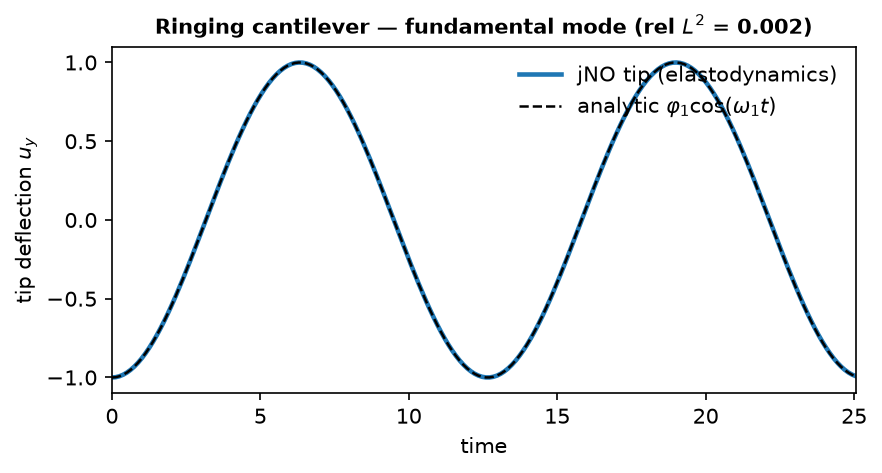
The tip rings as the exact modal cosine \(\varphi_1\cos(\omega_1 t)\) to rel-\(L^2\approx2\times10^{-3}\) over two periods, the discrete energy is conserved, the clamped root stays fixed to machine precision, and the FEM fundamental frequency matches beam theory to ~1%.
Full script
"""Elastodynamics + modal analysis: a ringing cantilever (vector, 2nd-order time) via ``jno.fem``.

The transient sibling of the static cantilever (linear-elasticity tutorial). A plane-stress elastic
beam clamped at the root obeys Newton's second law for a continuum,

    ρ u_tt = ∇·σ(u) ,    σ(u) = λ (∇·u) I + 2μ ε(u) ,    ε(u) = ½(∇u + ∇uᵀ) ,

with the **vector** displacement u = (u_x, u_y) carrying a *second* time derivative ``ui.tt`` --
``jno.fem`` auto-reduces this to the first-order system in y = [u, v=u_t] and integrates it with the
energy-conserving trapezoidal rule (θ=½; backward Euler would bleed the vibration away).

To prove the *dynamics* (not just that the integrator is conservative -- the trapezoidal rule
conserves a quadratic invariant of any linear block, even a wrong one) we do a small **modal
analysis**: the stiffness and mass bilinear forms give a generalized eigenproblem  K φ = ω² M φ
whose lowest mode (ω₁, φ₁) is the fundamental bending shape. That eigenproblem is stated the same way
the weak form is -- a term list plus ``mass=`` -- and solved by ``fem.eigs``, which eliminates the
clamped DOFs itself and returns M-orthonormal modes with **differentiable** eigenvalues (so ω₁ can be
an objective: mode-tuning, or inverting for a stiffness that hits a target frequency). Released from that mode at rest, the exact solution is
u(t) = φ₁ cos(ω₁ t), so the tip traces a clean cosine -- a direct check that the augmented [u, v]
block reproduces M ü + K u = 0 at the right frequency. As a bonus the modal frequency matches
Euler-Bernoulli beam theory  ω₁ ≈ (1.875/L)² √(E I / ρ A)  (Timoshenko & Goodier, *Theory of
Elasticity*).

Precision note: the fundamental bending mode of a slender beam is *soft* -- its modal stiffness is
several orders of magnitude below ‖K‖ -- so float32 assembly round-off shifts ω₁ by a few percent
(the ring comes out at the wrong speed while energy is still conserved). We enable float64 up front;
``jno.fem`` also warns when a second-order-time form is assembled without it.
"""

import jax

jax.config.update("jax_enable_x64", True)  # soft bending mode: not resolvable in float32

import jax.numpy as jnp  # noqa: E402
import numpy as np  # noqa: E402
from shapely.geometry import box  # noqa: E402

import jno  # noqa: E402

inner, symgrad, trace = jno.np.inner, jno.np.symgrad, jno.np.trace
dense = lambda A: jnp.asarray(A.todense()) if hasattr(A, "todense") else jnp.asarray(A)  # noqa: E731

E, nu, rho = 1000.0, 0.3, 1.0
lam, mu = E * nu / (1.0 - nu**2), E / (2.0 * (1.0 + nu))  # plane-stress Lamé parameters
L, H = 8.0, 1.0  # slender 8:1 beam (Euler-Bernoulli is a good reference)
Iz, Acs = H**3 / 12.0, H  # second moment / cross-section area (unit thickness)
omega_eb = (1.875 / L) ** 2 * np.sqrt(E * Iz / (rho * Acs))  # EB fundamental frequency (sets the window)
T_eb = 2.0 * np.pi / omega_eb

# integrate over two fundamental periods so the beam visibly rings (not a quarter swing)
d = jno.domain(box(0.0, 0.0, L, H), mesh_size=0.5, time=(0.0, float(2.0 * T_eb), 200))
u, phi = d.fem_symbols(value_shape=(2,), order=2)  # P2 vector displacement (TRI3 is too stiff in bending)
xi, yi, ti = d.variable("interior", split=True)
xl, yl, _ = d.variable("left", split=True)  # clamped root
xi0, yi0, ti0 = d.variable("initial", split=True)
ui, vi = u.bind(x=xi, y=yi, t=ti), phi.bind(x=xi, y=yi, t=ti)
ui0 = u.bind(x=xi0, y=yi0, t=ti0)

eu, ep = symgrad(u, [xi, yi]), symgrad(phi, [xi, yi])
weak = rho * inner(ui.tt, vi, n_contract=1) + lam * trace(eu) * trace(ep) + 2.0 * mu * inner(eu, ep, n_contract=2)
# Assemble the elastodynamics operators; the initial state is set from the eigenmode below, so the
# trivial (at-rest) IC here is just a placeholder.
fem = jno.fem([weak, u(xl, yl) - (0.0, 0.0), u(xi0, yi0) - (0.0, 0.0), ui0.t - (0.0, 0.0)])
assert fem.is_transient and fem.is_linear and fem.offsets == [0, fem.dofs // 2, fem.dofs]

M, A = np.asarray(dense(fem.M)), np.asarray(dense(fem.operator.A))
N = fem.offsets[1]  # state y = [u; v]; displacement = first N (node-major interleaved [n0x, n0y, ...])
M_uu, K_uu = M[:N, :N], A[N:, :N]  # mass and stiffness blocks of the augmented system

# --- modal analysis: K φ = ω² M φ, stated as a bilinear form and solved by ``fem.eigs`` ---
# ``eigs`` wants a steady, source-less form, so state the stiffness on its own -- the same
# λ tr(ε)tr(ε') + 2μ ε:ε' as above, minus the ρ u_tt term -- on the same symbols and the same
# clamped root. The essential BC is eliminated by the solver, so φ₁ already satisfies it.
uxy, vxy = u.bind(x=xi, y=yi), phi.bind(x=xi, y=yi)  # the same P2 space, read without t
K = jno.fem([lam * trace(eu) * trace(ep) + 2.0 * mu * inner(eu, ep, n_contract=2), u(xl, yl) - (0.0, 0.0)])
lam1, X1 = K.eigs(mass=[rho * inner(uxy, vxy, n_contract=1)], k=1)  # λ = ω², M-orthonormal φ
omega1 = float(jnp.sqrt(jnp.asarray(lam1).reshape(-1)[0]))
phi1 = np.asarray(X1)[:, 0]
phi1 = phi1 / np.max(np.abs(phi1))  # unit max displacement (a mode's amplitude is arbitrary)

pts = np.asarray(fem.points)
root = pts[:, 0] < 1e-9
clamped = np.sort(np.concatenate([np.where(root)[0] * 2, np.where(root)[0] * 2 + 1]))
assert phi1.size == N and np.max(np.abs(phi1[clamped])) < 1e-12  # same layout, BC eliminated

# --- release from the fundamental mode at rest and march with the trapezoidal (θ=½) rule ---
dt = float(fem.dt)
lhs, rhs_op = M + 0.5 * dt * A, M - 0.5 * dt * A  # (M+½dtA) y⁺ = (M−½dtA) y   [c = 0]
y = np.concatenate([phi1, np.zeros(N)])  # u(0) = φ₁, v(0) = 0
disp, vel = [y[:N].copy()], [y[N:].copy()]
for _ in range(round((fem.t1 - fem.t0) / dt)):
    y = np.linalg.solve(lhs, rhs_op @ y)
    disp.append(y[:N].copy())
    vel.append(y[N:].copy())
disp, vel = np.asarray(disp), np.asarray(vel)
ts = np.linspace(fem.t0, fem.t1, disp.shape[0])

# --- verify: the tip rings as the exact modal cosine, energy is conserved, the root stays clamped ---
tip = int(np.argmax(pts[:, 0]))
tip_y = disp[:, 2 * tip + 1]
analytic = tip_y[0] * np.cos(omega1 * ts)  # exact modal solution u(t) = φ₁ cos(ω₁ t)
rel = np.linalg.norm(tip_y - analytic) / np.linalg.norm(analytic)
energy = 0.5 * np.einsum("ti,ij,tj->t", vel, M_uu, vel) + 0.5 * np.einsum("ti,ij,tj->t", disp, K_uu, disp)
drift = float(np.max(np.abs(energy / energy[0] - 1.0)))
clamp = float(np.max(np.abs(disp[:, clamped])))

print(f"\nRinging cantilever (elastodynamics + modal analysis): dofs={fem.dofs}  P2 vector")
print(f"  fundamental ω₁(FEM) = {omega1:.4f}   Euler-Bernoulli ω₁ = {omega_eb:.4f}   ratio = {omega1 / omega_eb:.3f}")
print(f"  tip vs analytic φ₁·cos(ω₁ t) over 2 periods:  rel L2 = {rel:.4f}")
print(f"  energy drift = {drift:.4f}   clamped-root max |u| = {clamp:.2e}")

assert rel < 0.05, f"tip does not ring as the modal cosine: rel L2 = {rel:.4f}"  # correct dynamics + frequency
assert drift < 0.02, f"undamped elastodynamics must conserve energy (drift {drift:.4f})"
assert clamp < 1e-8, "clamped root must stay fixed"
assert abs(omega1 - omega_eb) / omega_eb < 0.15, "FEM fundamental frequency should match beam theory"