FNO2D — supervised Poisson 2D
Train a Fourier Neural Operator to learn the Poisson solution operator from a precomputed dataset of (f, u) pairs. Data-driven — no PDE residual is computed at training time; the network is supervised on solution targets.
Problem Setup
Solve −∇²u = f on [0,1]² with u = 0 on the boundary. The forcing f is sampled from a truncated sinusoidal basis (generate_poisson_data in create_domain.py, shipped alongside the tutorial script); the analytic solution u is computed in closed form on the same basis.
Step 1: Generate the Dataset
from create_domain import build_domain_from_arrays, generate_poisson_data

GRID, SAMPLES = 16, 256
forcing, solution = generate_poisson_data(SAMPLES, GRID, n_modes=5, alpha=1.5, seed=42)
domain = build_domain_from_arrays(forcing, solution, GRID)
_f = domain.variable("_f")
_u = domain.variable("_u")
forcing and solution are (256, 16, 16, 1) arrays. The domain attaches them as named tensors so the symbolic expression can reference them directly.
Step 2: FNO2D Architecture
u = jno.nn(
    foundax.fno2d(
        in_features=1,
        hidden_channels=16,
        n_modes=6,            # number of Fourier modes retained per axis
        d_vars=1,
        n_layers=2,
        n_steps=1,
        d_model=(GRID, GRID),
        norm="layer",
        linear_conv=True,
        key=jax.random.PRNGKey(0),
    )
)
u.optimizer(optax.chain(
    optax.clip_by_global_norm(1e-3),
    optax.adamw(optax.cosine_decay_schedule(5e-4, 600, alpha=1e-7 / 5e-4), weight_decay=1e-6),
))
Each FNO layer lifts the input to a hidden channel, transforms to Fourier space, mixes the lowest-n_modes coefficients via a learnable linear map, transforms back, combines with a residual conv, and normalises. The spectral mixing is what makes FNO efficient on smooth solutions of elliptic PDEs.
Step 3: Supervised Loss + Solve
The loss is a pure supervised MSE between the network's prediction u(_f) and the ground-truth solution _u. No .d(x), no .integrate(), no .mse on a residual — it's a regression problem.
Result
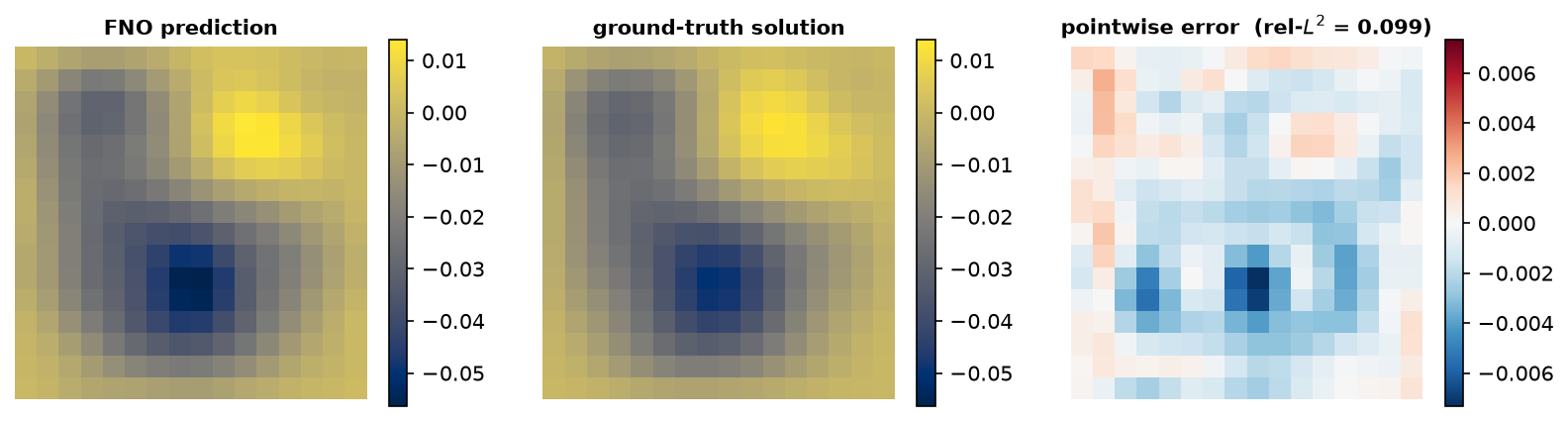
On eight held-out forcings drawn from an unseen RNG seed, the trained FNO reproduces the ground-truth Poisson solutions to a mean rel-\(L^2 \approx 0.10\); the representative sample shown above sits at rel-\(L^2 \approx 0.099\). All three panels are the operator's own output on data it never trained on.
What To Notice
- Data-driven, not physics-driven. FNO's strength is that it generalises to new forcing functions without retraining — once the operator is learnt, evaluating
u(f_new)for any in-distributionf_newis a single forward pass. - Spectral mixing is a strong prior for elliptic / parabolic PDEs whose solutions are smooth in Fourier space. For problems with sharp gradients or discontinuities, the spectral cutoff (
n_modes=6here) becomes the dominant approximation error. - Resolution independence in principle — the same FNO trained at
GRID=16can be evaluated at higher resolutions without architecture changes, because Fourier modes are mesh-agnostic. In practice the modes per axis (n_modes) needs to be matched to the target resolution.
Script Snippet
"""11 — Fourier Neural Operator 2D for Poisson operator learning"""

import foundax
import jax
import numpy as np
import optax
from create_domain import build_domain_from_arrays, generate_poisson_data

import jno

KEY = jax.random.PRNGKey(0)
GRID = 16
SAMPLES = 256
EPOCHS = 600
BATCH = 32

# ── Dataset ──────────────────────────────────────────────────────────────────
forcing, solution = generate_poisson_data(SAMPLES, GRID, n_modes=5, alpha=1.5, seed=42)
domain = build_domain_from_arrays(forcing, solution, GRID)
_f = domain.variable("_f")
_u = domain.variable("_u")

# ── Model ────────────────────────────────────────────────────────────────────
u = jno.nn(
    foundax.fno2d(
        in_features=1,
        hidden_channels=16,
        n_modes=6,
        d_vars=1,
        n_layers=2,
        n_steps=1,
        d_model=(GRID, GRID),
        norm="layer",
        linear_conv=True,
        key=KEY,
    )
)
u.optimizer(
    optax.chain(
        optax.clip_by_global_norm(1e-3),
        optax.adamw(optax.cosine_decay_schedule(5e-4, EPOCHS, alpha=1e-7 / 5e-4), weight_decay=1e-6),
    )
)

# ── Supervised loss + solve ─────────────────────────────────────────────────
crux = jno.core([(_u - u(_f)).mse])
crux.solve(epochs=EPOCHS, batchsize=BATCH)

# ── Held-out evaluation on unseen forcings (different RNG seed) ───────────────
N_TEST = 8
f_test, u_test = generate_poisson_data(N_TEST, GRID, n_modes=5, alpha=1.5, seed=123)
test_dom = build_domain_from_arrays(f_test, u_test, GRID)

# the trained operator's OWN prediction on the held-out forcings
pred = np.asarray(crux.eval([u(test_dom.variable("_f"))], domain=test_dom)).reshape(N_TEST, GRID, GRID)
truth = np.asarray(u_test).reshape(N_TEST, GRID, GRID)

rel = np.linalg.norm((pred - truth).reshape(N_TEST, -1), axis=1) / np.linalg.norm(truth.reshape(N_TEST, -1), axis=1)
sample = int(np.argmin(np.abs(rel - rel.mean())))  # a representative (near-mean) sample
print(f"held-out per-sample rel-L2: {np.array2string(rel, precision=3)}")
print(f"held-out mean rel-L2 = {float(rel.mean()):.4f}  (representative sample {sample}: {float(rel[sample]):.4f})")
assert rel.mean() < 0.2, float(rel.mean())