A Heated Box: Conduction + Convection + Radiation
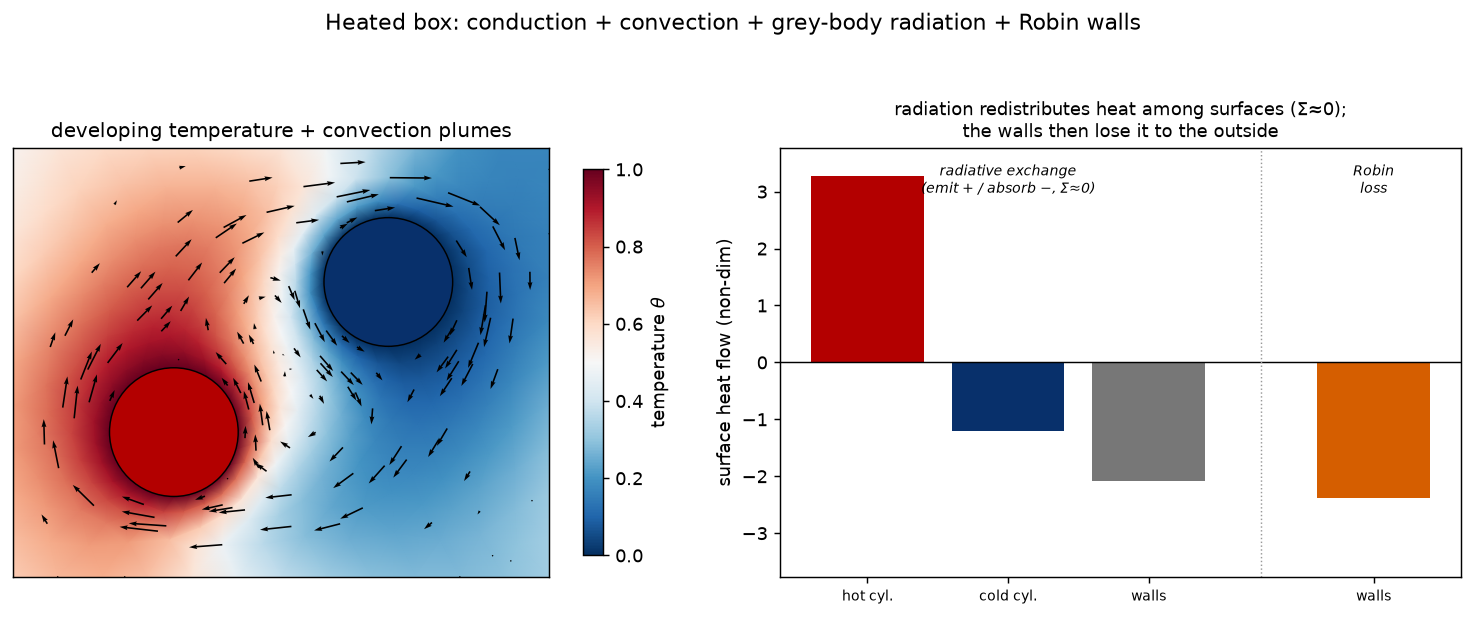
A rectangular box of air holds two solid cylinders — a hot one (a heater) low on the left and a
cold one high on the right — while the outer walls leak heat to a cooler outside. Heat moves between
the cylinders and out through the walls by three coupled routes, all in one jno.fem([...]):
conduction (lap T), convection (buoyancy lifts warm air off the hot cylinder and drops chilled
air off the cold one — the Boussinesq model, two interacting plumes), and radiation (the two
cylinders and the four walls form a grey-body enclosure; each surface radiates across the transparent
air to every other it can see, and the cylinders occlude each other).
Robin walls: the box leaks heat
The outer walls are neither fixed-temperature nor perfectly insulated — they lose heat to a cooler outside by Newton cooling, a Robin condition \(-\partial_\theta/\partial n = \mathrm{Bi}\,(\theta - \theta_\text{ext})\). It enters the weak form as a natural surface term on the wall tag:
robin = Bi * (T.bind(x=xo, y=yo) - T_ext) * sT.bind(x=xo, y=yo) # heat leaves where the wall is warm
The enclosure is the meshed fluid, with two obstacles
The cylinders are holes in the fluid mesh and the walls bound it, so radiation crosses the meshed
interior — element normals point inward (inward=True). The two cylinders also block rays, which the
view-factor builder handles by occlusion; a coarse curved mesh under-resolves the factors, so
enforce_closure=True rescales F to satisfy closure and reciprocity exactly (van Leersum 1989):
gap = d.enclosure(["hot", "cold", "outer"], inward=True, enforce_closure=True)
gap.check()                                  # closure ~1e-16, reciprocity ~1e-17
Temperature is the last field, so its DOFs are w[off[2]:] — exactly what gap.field/gap.load expect.
Each time step freezes the radiosity from the start-of-step wall temperatures (operator splitting:
robust, exact at steady state) and applies it as a consistent surface load, zeroed on the pinned
cylinder rows:
def q_rad(Tdofs):                            # grey-body radiosity, net flux leaving each wall element
    Tk = gap.field(Tdofs) + tau              # absolute non-dim temperature (T**4 is not offset-invariant)
    J  = jnp.linalg.solve(eye - rho[:, None] * F, eps * Tk**4)
    return J - F @ J

def rad_load(w):
    return jnp.zeros(fem.dofs).at[off[2]:].set(N_rc * gap.load(q_rad(w[off[2]:]), size=nT) * free_T)
What each physics does — validated, nothing painted in
Marched from a cold start with backward Euler + Newton, the box develops a two-plume circulation. The checks audit the computed field directly:
- convection develops vigorously (\(\max|u|\approx35\)), with a warm plume above the hot cylinder;
- radiation is energy-conserving over the closed enclosure (\(\sum_i A_i q_i \approx 0\) to machine precision) and the signs are physical — the hot cylinder emits, the cold one and the walls absorb (right panel above);
- Robin walls carry net heat out of the box to the cooler outside.
The animation is the computed temperature with the computed velocity arrows as the box warms; only the cylinder outlines are drawn, to mark the boundary conditions.
Reference: M. F. Modest, Radiative Heat Transfer, 3rd ed., Ch. 4–5 (the net-radiation / radiosity method for diffuse-grey enclosures).