How far the stabilised pair goes: the cavity to Re = 5000
The stabilised-flow tutorial verifies equal-order P1/P1 against a closed form at Re = 20. Stabilisation exists for convection-dominated flow, so that is a correctness check, not an envelope. This run measures the envelope, and checks the answer against the inf-sup-stable pair rather than against itself.
Two things carry the run
A regularised lid. The classical cavity drives the lid at constant speed, putting a discontinuity
— and a pressure singularity — in each top corner. Newton from rest does not survive it: measured, it
fails at Re = 100 already. 16x²(1−x)² is the standard fix.
Continuation in Re. Even regularised, a cold solve at Re = 1000 drives the iterate somewhere its
own tangent is exactly singular. nu is left as a jno.np.parameter, so the sweep is a solver slot,
not a hand-written loop:
nu = jno.np.parameter((1,), name="nu")          # in the form
...
fem.solve(nonlinear=jno.solve.newton(direct=True),
          linear=jno.solve.lu(backend="host"),
          continuation=jno.solve.continuation(nu=[1/re for re in ladder], keep="all"))
One fem.solve, not one per rung — the form compiles once and nu arrives as a runtime argument.
And continuation raises on the first rung that fails, so arriving at the top is the
convergence statement: there is no quietly-unconverged rung.
Measured
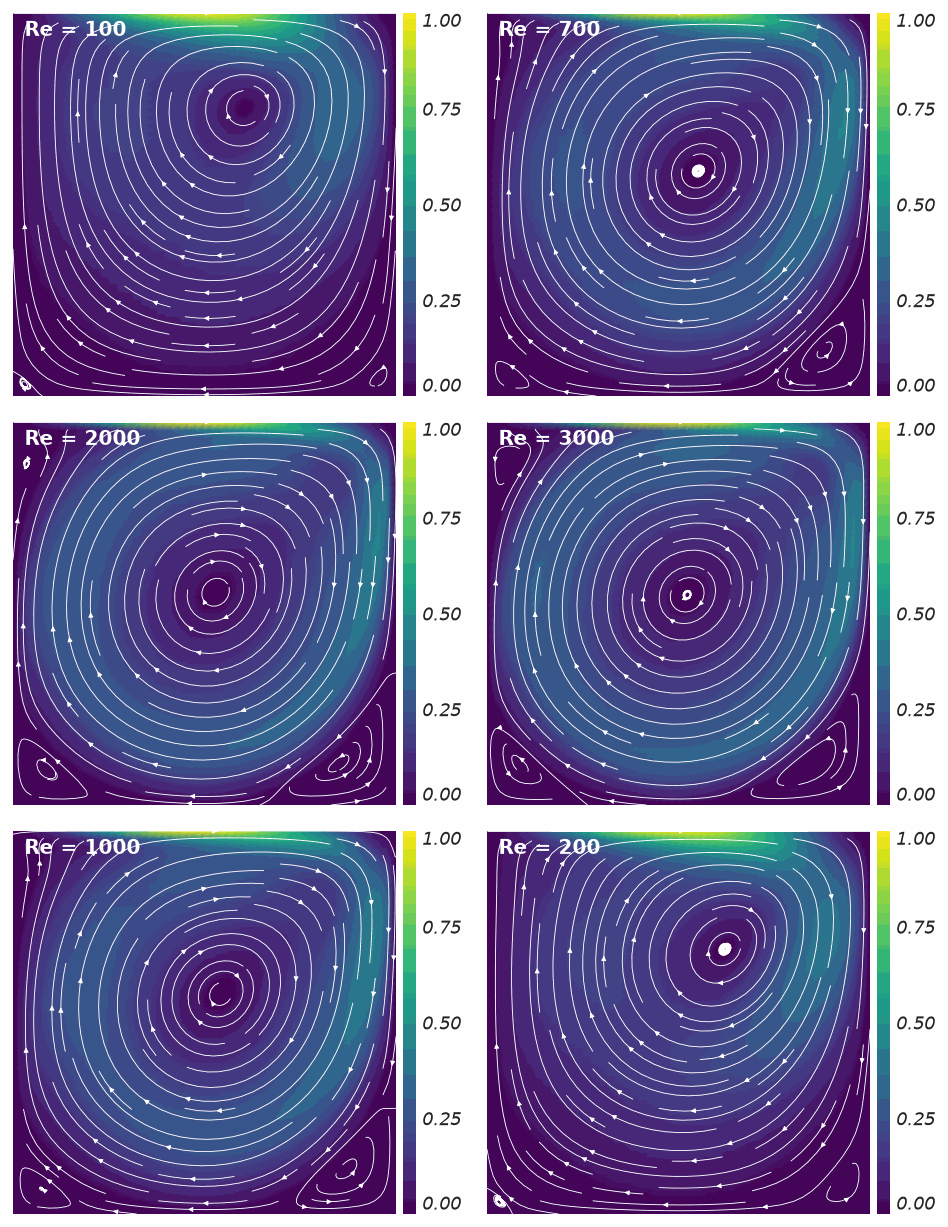
Every rung of the continuation ladder, in order. The three that the table below quotes, side by side for direct comparison:
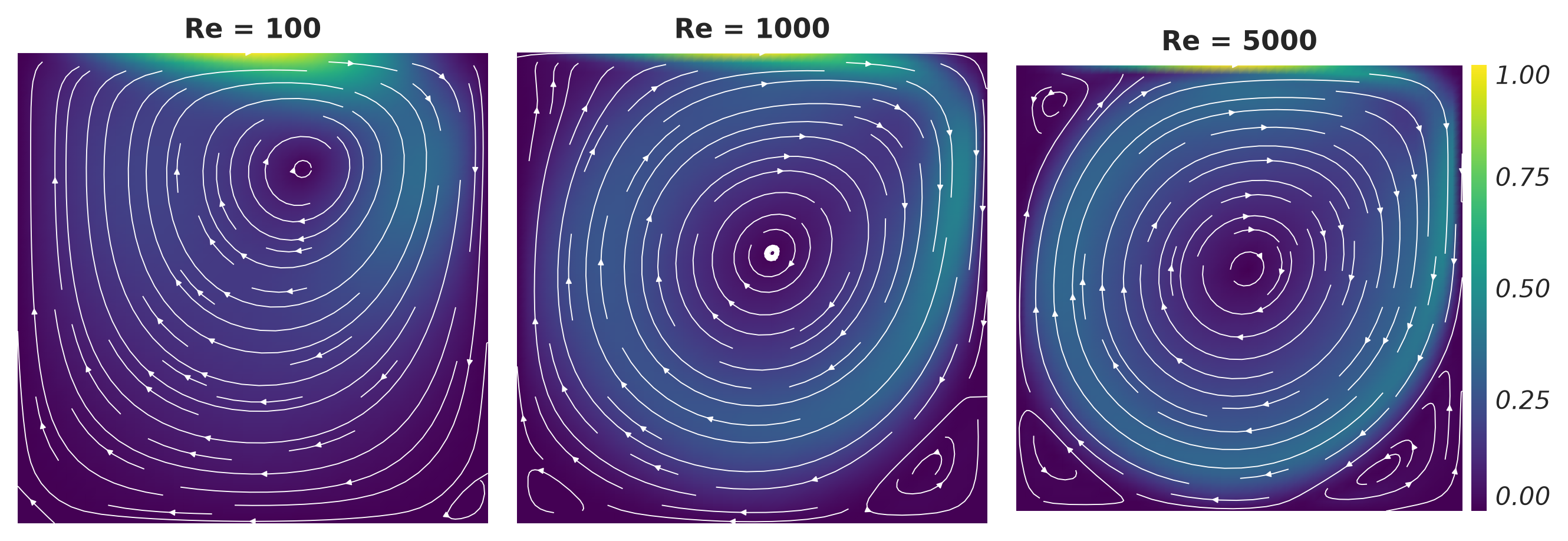
48×48 structured mesh, 7,203 DOFs. The primary vortex strengthens monotonically with Re — the classic cavity signature, and the vortex centre migrates toward the middle as the corner eddies grow:
| Re | min u_x on x = 0.5 |
u_y range on y = 0.5 |
|---|---|---|
| 100 | −0.1635 | −0.1954 … +0.1394 |
| 400 | −0.2340 | −0.3280 … +0.2109 |
| 1000 | −0.2761 | −0.3751 … +0.2604 |
| 2000 | −0.2985 | −0.3930 … +0.2879 |
| 5000 | −0.3312 | −0.4176 … +0.3277 |
Is the equal-order answer right?
P1/P1 violates the inf-sup condition and works only because PSPG compensates, so the check is Taylor–Hood P2/P1 — the stable pair — on the same mesh, at Re = 1000:
| max deviation | as % of profile range | |
|---|---|---|
u_x along x = 0.5 |
0.0093 | 0.7 % |
u_y along y = 0.5 |
0.0084 | 0.7 % |
for 2.9× fewer DOFs (7,203 vs 21,219). In 3-D that ratio grows — a P2 tet carries 10 nodes to P1's 4.
This is not a Ghia comparison
Ghia, Ghia & Shin (J. Comput. Phys. 48 (1982) 387) tabulate the cavity with a constant lid. The regularisation changes the driving profile, so these numbers are not comparable to that table, and they are not presented as validation against it. This is an internal cross-validation: the new pair against the established one, same mesh, same problem.
Scope
- Re = 5000 is where this run stopped, not a proven ceiling — nothing was tried above it.
- Steady solutions only, and what that means depends on the dimension. In 2-D the steady branch is reported stable up to Re ≈ 8000 (the first Hopf bifurcation), so these are legitimate steady solutions of the 2-D equations. A real, three-dimensional cavity is a different story — it develops spanwise (Taylor–Görtler) instabilities from Re ~ 10³ — so the Re = 5000 panel should not be read as a picture of a physical flow.
- The mesh is fixed at 48×48. No mesh-convergence study was run, so the values are resolution- dependent even where the two discretisations agree with each other.
Full script
"""**How far the stabilised pair goes** -- the lid-driven cavity from Re = 100 to Re = 5000, on
equal-order P1/P1, reached by continuation in the Reynolds number.

    (u.grad)u - nu lap u + grad p = 0,   div u = 0,   Re = U L / nu

Two questions this answers, both of which the stabilised-flow tutorial leaves open:

  1. **How high can Re go?** That tutorial verifies the formulation against a closed form at Re = 20.
     Stabilisation exists for convection-dominated flow, so Re = 20 is not an envelope.
  2. **Is the equal-order answer right?** P1/P1 is not an inf-sup-stable pair -- it works only because
     PSPG compensates. The check is Taylor-Hood P2/P1, the stable pair, on the same mesh.

Two things carry the run:

**A regularised lid.** The classical cavity drives the lid at a constant speed, which puts a
discontinuity -- and a pressure singularity -- in each top corner. Newton from rest does not survive
it: it fails here at Re = 100 already. `16 x^2 (1-x)^2` is the standard regularisation and is what the
other cavity tutorial uses too.

**Continuation in Re.** Even regularised, a cold Newton solve at Re = 1000 drives the iterate
somewhere its own tangent is singular. `nu` is a `jno.np.parameter`, so `fem.solve(continuation=...)`
sweeps it and warm-starts each solve from the last -- which is the textbook way to reach a high
Reynolds number, expressed as a solver slot rather than a hand-written loop.

NOT a Ghia comparison, and it should not be read as one. Ghia, Ghia & Shin (*J. Comput. Phys.* **48**
(1982) 387) tabulate the cavity with a CONSTANT lid; the regularisation above changes the driving
profile, so the numbers here are not comparable to that table. What this is instead is an INTERNAL
cross-validation -- the new, unstable-on-its-own pair against the established stable one, on the same
mesh and the same problem. That is the question this branch actually raises.
"""

import os

os.environ.setdefault("XLA_PYTHON_CLIENT_MEM_FRACTION", "0.6")

import jax

jax.config.update("jax_enable_x64", True)

import numpy as np  # noqa: E402

import jno  # noqa: E402

inner, grad, trace, lap = jno.np.inner, jno.np.grad, jno.np.trace, jno.np.laplacian

N = 48  # structured n x n mesh
C_I = 36.0  # inverse-estimate constant, linear elements (Tezduyar & Osawa, CMAME 190 (2000) Sec. 3)
RE_LADDER = [100.0, 200.0, 400.0, 700.0, 1000.0, 1500.0, 2000.0, 3000.0, 5000.0]


def cavity(n=N, order=1, stabilised=True):
    """The cavity with `nu` left as a runtime parameter, so continuation can sweep it."""
    d = jno.shape.rect(0.0, 0.0, 1.0, 1.0).structured(n=n).domain()
    d.tag("lid", lambda x, y: y > 1 - 1e-9)
    d.tag("wall", lambda x, y: (y < 1e-9) | (x < 1e-9) | (x > 1 - 1e-9))
    d.point_region("ppin", (0.0, 0.0))

    nu = jno.np.parameter((1,), name="nu")
    u, v = d.fem_symbols(value_shape=(2,), names=("u", "v"), order=order)
    p, q = d.fem_symbols(names=("p", "q"), order=1)
    xi, yi = d.variable("interior", split=True)[:2]
    xl, yl = d.variable("lid", split=True)[:2]
    xw, yw = d.variable("wall", split=True)[:2]
    xpn, ypn = d.variable("ppin", split=True)[:2]

    ub, vv = u.bind(x=xi, y=yi), v.bind(x=xi, y=yi)
    gu, gv = grad(u, [xi, yi]), grad(v, [xi, yi])
    gp, gq = grad(p, [xi, yi]), grad(q, [xi, yi])
    pp, qq = p.bind(x=xi, y=yi), q.bind(x=xi, y=yi)

    div = lambda gw: trace(gw)  # noqa: E731
    adv = lambda gw, w: inner(gw, w, n_contract=1)  # noqa: E731  -- (w.grad)w

    momentum = inner(adv(gu, ub), vv, n_contract=1) + nu * inner(gu, gv, n_contract=2) - pp * div(gv)
    continuity = -qq * div(gu)

    if stabilised:
        G = d.cell_metric
        gG = lambda a: inner(a, inner(G, a, n_contract=1), n_contract=1)  # noqa: E731
        tau = jno.lag((gG(ub) + C_I * nu**2 * inner(G, G, n_contract=2)) ** -0.5)
        r_m = adv(gu, ub) - nu * lap(u, [xi, yi]) + gp
        momentum = momentum + tau * inner(adv(gv, ub), r_m, n_contract=1)  # SUPG -> momentum   (+)
        continuity = continuity - tau * inner(gq, r_m, n_contract=1)  # PSPG -> continuity (-)

    lid_profile = 16.0 * xl**2 * (1 - xl) ** 2  # regularised: zero at both top corners
    return d, jno.fem(
        [
            momentum,
            continuity,
            u(xl, yl)[0] - lid_profile,
            u(xl, yl)[1] - 0.0,
            u(xw, yw)[0] - 0.0,
            u(xw, yw)[1] - 0.0,
            p(xpn, ypn) - 0.0,
        ]
    )


def velocity(fem, sol):
    """`(points, u)` for the velocity block -- `fem.points` is that field's own node set."""
    pts = np.asarray(fem.points)
    return pts, sol[fem.offsets[0] : fem.offsets[1]].reshape(len(pts), 2)


def centreline(pts, uv, axis, at=0.5, tol=1e-9):
    """The profile along a cavity centreline, as `(coordinate, u_x, u_y)` sorted along the line."""
    keep = np.abs(pts[:, axis] - at) < tol
    other = 1 - axis
    order = np.argsort(pts[keep, other])
    return pts[keep, other][order], uv[keep, 0][order], uv[keep, 1][order]


def climb(fem, ladder, keep="all"):
    """Climb the Reynolds ladder, warm-starting each rung from the one below.

    ONE `fem.solve`, not one per rung: the form is compiled once and `nu` arrives as a runtime
    argument, so an n-rung ladder is n solves rather than n rebuilds and n compilations.
    """
    sol = fem.solve(
        nonlinear=jno.solve.newton(direct=True, rtol=1e-9, atol=1e-9),
        linear=jno.solve.lu(backend="host"),
        continuation=jno.solve.continuation(nu=[1.0 / r for r in ladder], keep=keep),
    )
    return np.asarray(sol)


print(f"\nLid-driven cavity, {N}x{N} structured mesh")
print("=" * 62)

# ---- 1. how far the stabilised equal-order pair goes -------------------------------------------
d_s, fem_s = cavity(order=1, stabilised=True)
print(f"stabilised P1/P1 : {fem_s.dofs:6d} dofs")
# `fem.solve(continuation=...)` RAISES on the first rung that fails to converge, so arriving at the
# top of the ladder is itself the convergence statement -- there is no quietly-unconverged rung.
family = climb(fem_s, RE_LADDER, keep="all")  # (n_rungs, n_dofs)
reached = {re: family[i] for i, re in enumerate(RE_LADDER)}
print("     Re    min u_x on x=0.5    u_y range on y=0.5")
for re in RE_LADDER:
    pts, uv = velocity(fem_s, reached[re])
    assert np.isfinite(uv).all(), f"Re = {re:.0f} returned a non-finite field"
    _y, ux, _ = centreline(pts, uv, axis=0)
    _x, _, uy = centreline(pts, uv, axis=1)
    # The primary vortex strengthens monotonically with Re -- the classic cavity signature.
    print(f"  {re:6.0f}      {ux.min():+.4f}          {uy.min():+.4f} .. {uy.max():+.4f}")

# ---- 2. is it right? Taylor-Hood, the inf-sup-STABLE pair, on the same mesh ----------------------
d_t, fem_t = cavity(order=2, stabilised=False)
print(f"\nTaylor-Hood P2/P1: {fem_t.dofs:6d} dofs  ({fem_t.dofs / fem_s.dofs:.1f}x the equal-order pair)")
sol_t = climb(fem_t, [r for r in RE_LADDER if r <= 1000.0], keep="last")

pts_s, uv_s = velocity(fem_s, reached[1000.0])
pts_t, uv_t = velocity(fem_t, sol_t)
ys, ux_s, _ = centreline(pts_s, uv_s, axis=0)  # u_x along the vertical centreline x = 0.5
yt, ux_t, _ = centreline(pts_t, uv_t, axis=0)
xs, _, uy_s = centreline(pts_s, uv_s, axis=1)  # u_y along the horizontal centreline y = 0.5
xt, _, uy_t = centreline(pts_t, uv_t, axis=1)

# Compare on the coarse (P1) node set; the P2 profile is sampled there by interpolation along the line.
ux_ref = np.interp(ys, yt, ux_t)
uy_ref = np.interp(xs, xt, uy_t)
e_u = float(np.max(np.abs(ux_s - ux_ref)))
e_v = float(np.max(np.abs(uy_s - uy_ref)))
span = float(max(np.ptp(ux_ref), np.ptp(uy_ref)))

print("\nRe = 1000 centreline profiles, equal-order vs Taylor-Hood on the same mesh:")
print(f"  max |du_x| along x=0.5 : {e_u:.4f}   ({100 * e_u / span:.1f}% of the profile range)")
print(f"  max |du_y| along y=0.5 : {e_v:.4f}   ({100 * e_v / span:.1f}% of the profile range)")
print(f"  extrema  u_x: {ux_s.min():+.4f} / {ux_s.max():+.4f}   Taylor-Hood {ux_ref.min():+.4f} / {ux_ref.max():+.4f}")
print(f"           u_y: {uy_s.min():+.4f} / {uy_s.max():+.4f}   Taylor-Hood {uy_ref.min():+.4f} / {uy_ref.max():+.4f}")

assert e_u < 0.10 * span, f"equal-order disagrees with the stable pair by {e_u:.3f}"
assert e_v < 0.10 * span, f"equal-order disagrees with the stable pair by {e_v:.3f}"
print(f"\nStabilised equal-order P1/P1 reached Re = {max(reached):.0f} and tracks the stable pair at Re = 1000.")