Navier–Stokes — Cylinder (DFG benchmark 2D-1)
Steady Navier–Stokes past a cylinder at \(Re = 20\), checked against published reference values rather than against a manufactured solution or against jNO itself:
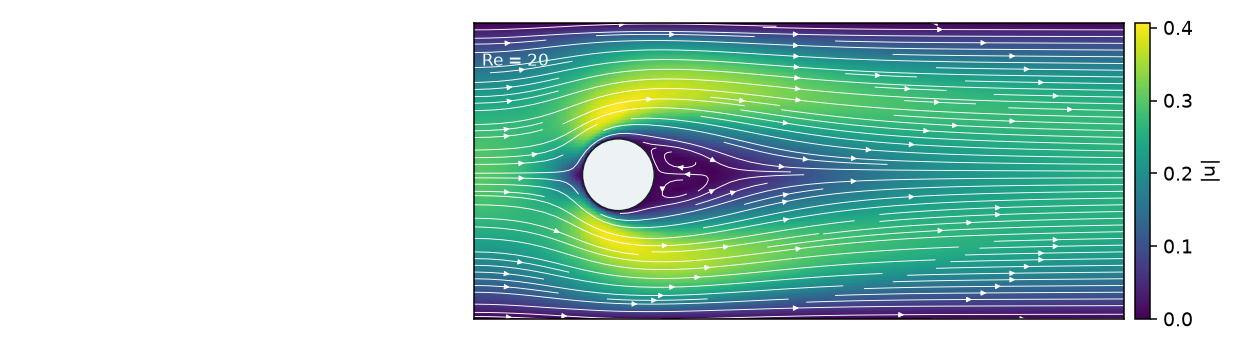
Result
Configuration and reference values from Schäfer & Turek (1996), the DFG/Featflow benchmark. Taylor–Hood P2/P1, 10,038 DOF, one direct solve of about five seconds:
| quantity | jNO | reference | error |
|---|---|---|---|
| \(c_D\) | 5.57377 | 5.57953523384 | 0.10 % |
| \(\Delta p\) | 0.11666 | 0.11752016697 | 0.73 % |
| \(c_L\) | 0.01041 | 0.010618948146 | 1.93 % |
Refining further drives the drag error to 0.02 % (0.39 → 0.10 → 0.04 → 0.02 % over four meshes).
The outflow is written by not writing it
Only the inlet, the walls and the cylinder carry terms. The downstream face is left untagged, and an
untagged boundary is do-nothing in jNO — exactly the traction-free outflow this problem wants.
That also fixes the pressure level, which is why no p.pin() appears anywhere here. (An
enclosed flow does have a constant pressure null space and needs a gauge — p.pin(mean=True).)
Forces are reactions, not surface integrals
fem.eval(term, u) assembles the momentum residual with no essential elimination applied, so
summing it over the cylinder's constrained DOFs gives the force holding the cylinder in place; the
force the fluid exerts is its negative:
free  = np.asarray(fem.eval(momentum, sol))
scale = 2.0 / (UMEAN**2 * DIA)
cD    = -scale * float(free[fem.region_dofs("cyl", field=u, component=0)].sum())
cL    = -scale * float(free[fem.region_dofs("cyl", field=u, component=1)].sum())
This is the accurate way to extract a force from a finite element solution — the reaction is exactly conjugate to the constraint, whereas a surface stress integral differentiates the solution and loses an order.
A caveat worth stating: lift is not drag
\(c_L\) is not held to a tight tolerance in the accompanying test, and should not be. The cylinder centre sits at \(y = 0.2\) in a channel of height \(0.41\) — 0.005 off the axis — so the lift is a small residue of two nearly-cancelling forces and is dominated by the random asymmetry of an unstructured mesh. Measured over four refinements the drag error falls 0.39 → 0.10 → 0.04 → 0.02 % while the lift error wanders 6.9 → 1.9 → 3.8 → 6.7 %. The sign and order of magnitude reproduce; the digits do not. Getting lift to benchmark accuracy needs a symmetric or boundary-fitted mesh, which is a different piece of work.
\(\Delta p\) carries a smaller version of the same caveat: it is read at the nearest pressure node to each probe point, so part of its error is the node offset rather than the solution — 0.00 % on meshes that happen to land a node on the point, 0.3–0.7 % otherwise.
Full script
"""**DFG benchmark 2D-1** — steady Navier–Stokes past a cylinder at Re = 20, checked against the
published reference values rather than against a manufactured solution.

    (u.grad)u - nu lap u + grad p = 0,   div u = 0,   Re = U_mean D / nu = 20

Configuration and reference values are Schäfer & Turek (1996), the DFG/Featflow benchmark:

    domain     [0, 2.2] x [0, 0.41] minus a disk of radius 0.05 at (0.2, 0.2)
    inflow     u = (4 U y (0.41 - y) / 0.41^2, 0),  U = 0.3  ->  U_mean = 2/3 U = 0.2
    cD, cL     2 F / (U_mean^2 D)          dP  p(0.15, 0.2) - p(0.25, 0.2)
    reference  cD = 5.57953523384   cL = 0.010618948146   dP = 0.11752016697

Two jNO-specific things carry this example. The **outflow is written by not writing it** — an
untagged boundary is do-nothing, which is the traction-free condition an outlet wants, and it fixes
the pressure level so no `p.pin()` appears anywhere. And the **forces are reactions**: `fem.eval`
assembles the momentum residual with no essential elimination, so the sum over the cylinder's
constrained DOFs is the force holding it in place. That is the accurate route to a force from a
finite element solution (John, *Int. J. Numer. Meth. Fluids* 44, 2004) — better than integrating
stress over the surface.
"""

import os

os.environ.setdefault("XLA_PYTHON_CLIENT_MEM_FRACTION", "0.6")

import jax

jax.config.update("jax_enable_x64", True)

import numpy as np  # noqa: E402

import jno  # noqa: E402

inner, grad, trace = jno.np.inner, jno.np.grad, jno.np.trace

L, H = 2.2, 0.41
CX, CY, RR = 0.2, 0.2, 0.05
UMAX, NU = 0.3, 1e-3
UMEAN, DIA = 2.0 / 3.0 * UMAX, 2.0 * RR
EPS = 1e-9
CD_REF, CL_REF, DP_REF = 5.57953523384, 0.010618948146, 0.11752016697

# CSG, with a finer size on the disk: drag accuracy lives on the boundary layer around the cylinder.
shape = jno.shape.rect(0, 0, L, H, size=0.035) - jno.shape.disk(CX, CY, RR, size=0.006)
d = shape.domain()
d.tag("inlet", lambda x, y: x < EPS)
d.tag("walls", lambda x, y: (y < EPS) | (y > H - EPS))
d.tag("cyl", lambda x, y: (x - CX) ** 2 + (y - CY) ** 2 < (RR + 1e-4) ** 2)

u, v = d.fem_symbols(value_shape=(2,), names=("u", "v"), order=2)  # P2 velocity
p, q = d.fem_symbols(names=("p", "q"), order=1)  # P1 pressure  -> Taylor-Hood
xi, yi = d.variable("interior", split=True)[:2]
xin, yin = d.variable("inlet", split=True)[:2]
xw, yw = d.variable("walls", split=True)[:2]
xc, yc = d.variable("cyl", split=True)[:2]

gu, gv = grad(u, [xi, yi]), grad(v, [xi, yi])
ub, vv = u.bind(x=xi, y=yi), v.bind(x=xi, y=yi)
pp, qq = p.bind(x=xi, y=yi), q.bind(x=xi, y=yi)
conv = inner(gu, ub, n_contract=1)  # (u.grad)u
momentum = inner(conv, vv, n_contract=1) + NU * inner(gu, gv, n_contract=2) - pp * trace(gv)
profile = 4.0 * UMAX * yin * (H - yin) / H**2

fem = jno.fem(
    [
        momentum,
        -qq * trace(gu),
        u(xin, yin)[0] - profile,  # parabolic inflow
        u(xin, yin)[1] - 0.0,
        u(xw, yw)[0] - 0.0,  # no-slip channel walls
        u(xw, yw)[1] - 0.0,
        u(xc, yc)[0] - 0.0,  # no-slip cylinder
        u(xc, yc)[1] - 0.0,
    ]  # the outlet gets nothing: natural (do-nothing), and it sets the pressure level
)
assert not fem.is_linear, "Re=20 keeps the convective term, so the system is nonlinear"
print(f"\nDFG 2D-1, steady Navier-Stokes past a cylinder (Re={UMEAN * DIA / NU:.0f}): dofs={fem.dofs}")

sol = np.asarray(fem.solve(linear=jno.solve.lu(backend="host")))  # saddle system -> direct

# ---- drag and lift as the reaction conjugate to the cylinder's no-slip constraint ----
free = np.asarray(fem.eval(momentum, sol))
scale = 2.0 / (UMEAN**2 * DIA)
cD = -scale * float(free[fem.region_dofs("cyl", field=u, component=0)].sum())
cL = -scale * float(free[fem.region_dofs("cyl", field=u, component=1)].sum())

off = fem.offsets
pre, ppts = sol[off[1] :], np.asarray(fem.field_points[1])
probe = lambda pt: float(pre[int(np.argmin(np.sum((ppts - np.asarray(pt)) ** 2, axis=1)))])  # noqa: E731
dP = probe((CX - RR, CY)) - probe((CX + RR, CY))

print(f"  cD = {cD:9.5f}   reference {CD_REF:9.5f}   ({100 * abs(cD - CD_REF) / CD_REF:.2f}%)")
print(f"  cL = {cL:9.5f}   reference {CL_REF:9.5f}   ({100 * abs(cL - CL_REF) / CL_REF:.2f}%)")
print(f"  dP = {dP:9.5f}   reference {DP_REF:9.5f}   ({100 * abs(dP - DP_REF) / DP_REF:.2f}%)")

assert abs(cD - CD_REF) / CD_REF < 5e-3
assert abs(dP - DP_REF) / DP_REF < 1.5e-2
# Lift is NOT held tightly: the cylinder sits 0.005 off the channel axis, so cL is a small residue
# of nearly-cancelling forces and is dominated by the random asymmetry of an unstructured mesh.
# Across four refinements the drag error goes 0.39 / 0.10 / 0.04 / 0.02 % while the lift error
# wanders 6.9 / 1.9 / 3.8 / 6.7 %. Sign and magnitude are what reproduce here.
assert 0.0 < cL < 5.0 * CL_REF