Thermal Barrier Coating — two meshes, one solve
A thin ceramic coating (\(L = 0.05\), \(k = 1\)) sits on a thick metal substrate (\(L = 1.0\), \(k = 20\)). A layer 20× thinner, of a material 20× less conductive, carries the same temperature drop as the entire substrate beneath it — because conduction in series adds thermal resistances \(L/k\), and here both contribute \(0.05\).
With a steady flux \(q\) injected at the top and \(T = 0\) held at the base, the exact 1-D solution is piecewise linear with a kink at the interface:
So the coating — 5 % of the thickness — is responsible for half the temperature rise. That is what makes it a barrier, and it is also what makes it hard to mesh: all the action is inside a sliver.
Why two meshes
Resolving the gradient through the coating needs several elements across \(0.05\), so \(h \approx 0.0125\). The substrate is happy at \(h \approx 0.12\), ten times coarser. One conforming mesh cannot honour both at the shared interface — it has to pick a single size there and compromise.
What one mesh actually gives you, on this geometry
| coating \(h\) (asked 0.0125) | substrate \(h\) (asked 0.12) | |
|---|---|---|
conforming=True |
0.0227 | 0.0995 |
conforming=False |
0.0119 | 0.1084 |
Fragmenting the two bodies into one mesh under-resolves the layer you care about and over-refines the bulk you do not.
Meshing each body independently and gluing them with a tie u(A) - u(B) gets both right. The two
interface surfaces then carry different node layouts, so jno.fem couples them with a mortar
(integrated) constraint rather than node-to-node matching — see
Tying two boundaries.
The term list
Two bodies, each meshed at its own size; conforming=False skips the fragment, so the shared surface
exists twice — once per body — and each is meshed independently.
d = jno.shape.regions(
    substrate=jno.shape.rect(0.0, 0.0, 1.0, L_SUB, size=H_SUB),
    coating=jno.shape.rect(0.0, L_SUB, 1.0, L_SUB + L_FILM, size=H_FILM),
    conforming=False,
).domain()

fem = jno.fem([
    K_SUB  * (Ts.x * ps.x + Ts.y * ps.y),    # steady conduction in the metal substrate
    K_FILM * (Tc.x * pc.x + Tc.y * pc.y),    # ... and in the ceramic coating
    -Q * phi.bind(x=xt, y=yt),               # flux in at the top (a natural BC)
    T(*a) - T(*b),                           # glue the two bodies
    T(xb, yb) - 0.0,                         # T = 0 at the base
])
One conduction term per material region — each integrates over that region's cells only. The tie is one more entry in the same list.
In u(A) - u(B), the first argument must be the finer side
A is the secondary: its interface DOFs are eliminated in favour of an interpolation from
the main side. Put the coarse side first and the fine mesh's resolution at the interface is
thrown away. Measured here:
| secondary | interface nodes | \(T_\text{interface}\) | error |
|---|---|---|---|
coating (finer) |
81 | 0.05000 | exact |
substrate (coarser) |
10 | 0.05531 | 10.62 % |
Nothing raises — both orders assemble and solve.
Result
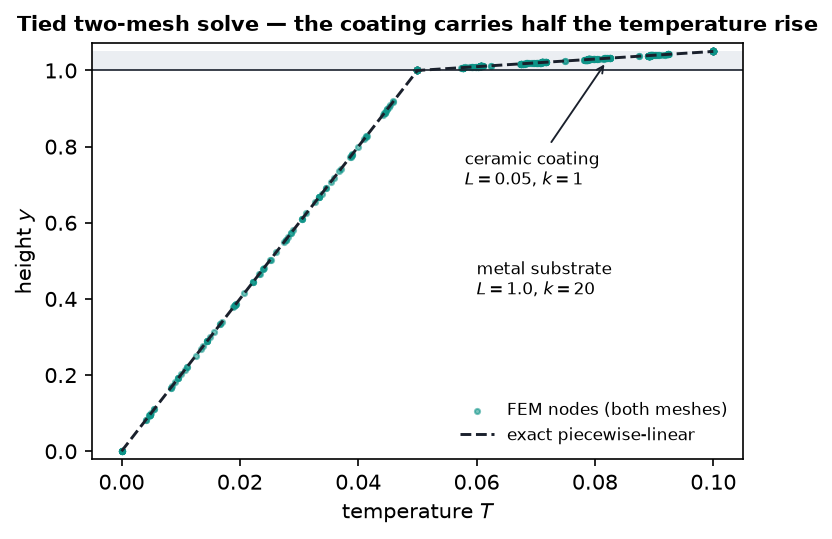
Coating (tied, two mesh resolutions): dofs=620
  T at interface  FEM=0.05000  exact=0.05000
  T at top        FEM=0.10000  exact=0.10000
  the 0.05-thick coating carries 50% of the temperature rise
Both probes hit the series-resistance solution to five decimals, across a tied interface whose two sides have different node counts. The script asserts both to within 2 %.
Full script
"""16 - Thermal barrier coating: two bodies, two mesh resolutions, one solve (``conforming=False``).

A thin ceramic coating (thickness 0.05, k = 1) on a thick metal substrate (thickness 1.0, k = 20).
This is the geometry of a thermal barrier coating, and its point is that a layer **20x thinner** made of
a material **20x less conductive** carries the *same* temperature drop as the whole substrate beneath
it: conduction in series adds thermal resistances L/k, and here both layers contribute 0.05.

With a steady flux q injected at the top and T = 0 held at the base, the exact 1-D solution is
piecewise linear with a kink at the interface::

    T_interface = q L_sub / k_sub                      = 1 * 1.00 / 20 = 0.050
    T_top       = T_interface + q L_film / k_film      + 1 * 0.05 /  1 = 0.100

so the coating -- 5 % of the thickness -- is responsible for half the temperature rise. That is what
makes it a *barrier*, and it is also what makes it hard to mesh: all the action is inside a sliver.

**Why two meshes.** Resolving the gradient through the coating needs several elements across 0.05, so
h ~ 0.0125; the substrate is happy at h ~ 0.12, ten times coarser. One conforming mesh cannot honour
both at the shared interface -- it has to pick a single size there and compromise. Measured on this
geometry, fragmenting the two bodies into one mesh gives:

    conforming      coating h = 0.0227 (asked 0.0125)   substrate h = 0.0995 (asked 0.12)
    conforming=False coating h = 0.0119 (asked 0.0125)  substrate h = 0.1084 (asked 0.12)

i.e. it under-resolves the layer you care about *and* over-refines the bulk you do not. Meshing each
body independently and gluing them with a tie ``u(A) - u(B)`` gets both right. The two interface
surfaces then carry different node layouts, so ``jno.fem`` couples them with a **mortar** (integrated)
constraint rather than node-to-node matching -- see ``docs/fem/boundary-conditions.md``, "Tying two boundaries".

Verified against the exact series-resistance solution above, at the interface and at the top surface.
"""

import numpy as np

import jno

K_SUB, K_FILM = 20.0, 1.0  # metal substrate / ceramic coating conductivity
L_SUB, L_FILM = 1.0, 0.05  # thicknesses
Q = 1.0  # heat flux injected at the top surface
H_SUB, H_FILM = 0.12, 0.0125  # per-region mesh sizes: the coating needs ~4 elements through thickness

# Two bodies, each meshed at its OWN size. `conforming=False` skips the fragment, so the shared
# surface exists twice -- once per body -- and each is meshed independently.
d = jno.shape.regions(
    substrate=jno.shape.rect(0.0, 0.0, 1.0, L_SUB, size=H_SUB),
    coating=jno.shape.rect(0.0, L_SUB, 1.0, L_SUB + L_FILM, size=H_FILM),
    conforming=False,
).domain()
# `shape` already auto-names each body's edges, and with the two bodies stacked the outer `bottom`
# (y = 0, on the substrate) and `top` (y = 1.05, on the coating) are exactly the two surfaces wanted.

T, phi = d.fem_symbols()
# One conduction term per material region -- each integrates over that region's cells only. (The
# the `d.attach(region, k=...)` shorthand is for regions declared as geometry parts or `d.tag` predicates; a
# `shape.regions` name is not one of those, so with two materials the explicit form is also the
# clearer one.)
xs, ys, _ = d.variable("substrate", split=True)
xc, yc, _ = d.variable("coating", split=True)
Ts, ps = T.bind(x=xs, y=ys), phi.bind(x=xs, y=ys)
Tc, pc = T.bind(x=xc, y=yc), phi.bind(x=xc, y=yc)

# The two sides of the interface. The shared surface exists TWICE -- once per body, at identical
# coordinates -- so a spatial predicate selects both; `region=` names which body owns the facets, and
# is the only thing that can tell them apart.
#
# ORDER MATTERS: in `u(A) - u(B)` the first is the SECONDARY, whose interface DOFs are eliminated in favour
# of an interpolation from the main, so the secondary must be the *finer* side or the fine mesh's
# resolution at the interface is discarded. Measured here:
#     secondary = coating   (81 interface nodes)  ->  T_interface = 0.05000   exact
#     secondary = substrate (10 interface nodes)  ->  T_interface = 0.05531   10.62% error
on_interface = lambda x, y: np.abs(y - L_SUB) < 1e-9  # noqa: E731
a = d.variable("film_face", where=on_interface, region="coating", split=True)  # secondary: the finer side
b = d.variable("base_face", where=on_interface, region="substrate", split=True)  # main

xt, yt, _ = d.variable("top", split=True)  # coating outer surface: flux q in
xb, yb, _ = d.variable("bottom", split=True)  # substrate base: T = 0

fem = jno.fem(
    [
        K_SUB * (Ts.x * ps.x + Ts.y * ps.y),  # steady conduction in the metal substrate
        K_FILM * (Tc.x * pc.x + Tc.y * pc.y),  # ... and in the ceramic coating
        -Q * phi.bind(x=xt, y=yt),  # flux in at the top (a natural BC)
        T(*a) - T(*b),  # glue the two bodies
        T(xb, yb) - 0.0,  # T = 0 at the base
    ]
)
sol = np.asarray(fem.solve()).reshape(-1)
pts = np.asarray(fem.points)

exact_iface = Q * L_SUB / K_SUB
exact_top = exact_iface + Q * L_FILM / K_FILM
# 1e-6, not 1e-9: `fem.points` is float32 by default, whose resolution at y ~ 1 is ~1.2e-7, so a
# 1e-9 band selects nothing at all and the mean comes back NaN.
got_iface = float(sol[np.abs(pts[:, 1] - L_SUB) < 1e-6].mean())
got_top = float(sol[pts[:, 1] > L_SUB + L_FILM - 1e-6].mean())

print(
    f"\nCoating (tied, two mesh resolutions): dofs={fem.dofs}\n"
    f"  T at interface  FEM={got_iface:.5f}  exact={exact_iface:.5f}\n"
    f"  T at top        FEM={got_top:.5f}  exact={exact_top:.5f}\n"
    f"  the 0.05-thick coating carries {100 * (got_top - got_iface) / got_top:.0f}% of the temperature rise"
)
assert abs(got_iface - exact_iface) / exact_top < 0.02
assert abs(got_top - exact_top) / exact_top < 0.02